
90%
drop in cost per install on FESTAS, our own product, once budget and creative followed consolidated app attribution (AppsFlyer) instead of platform last-click.
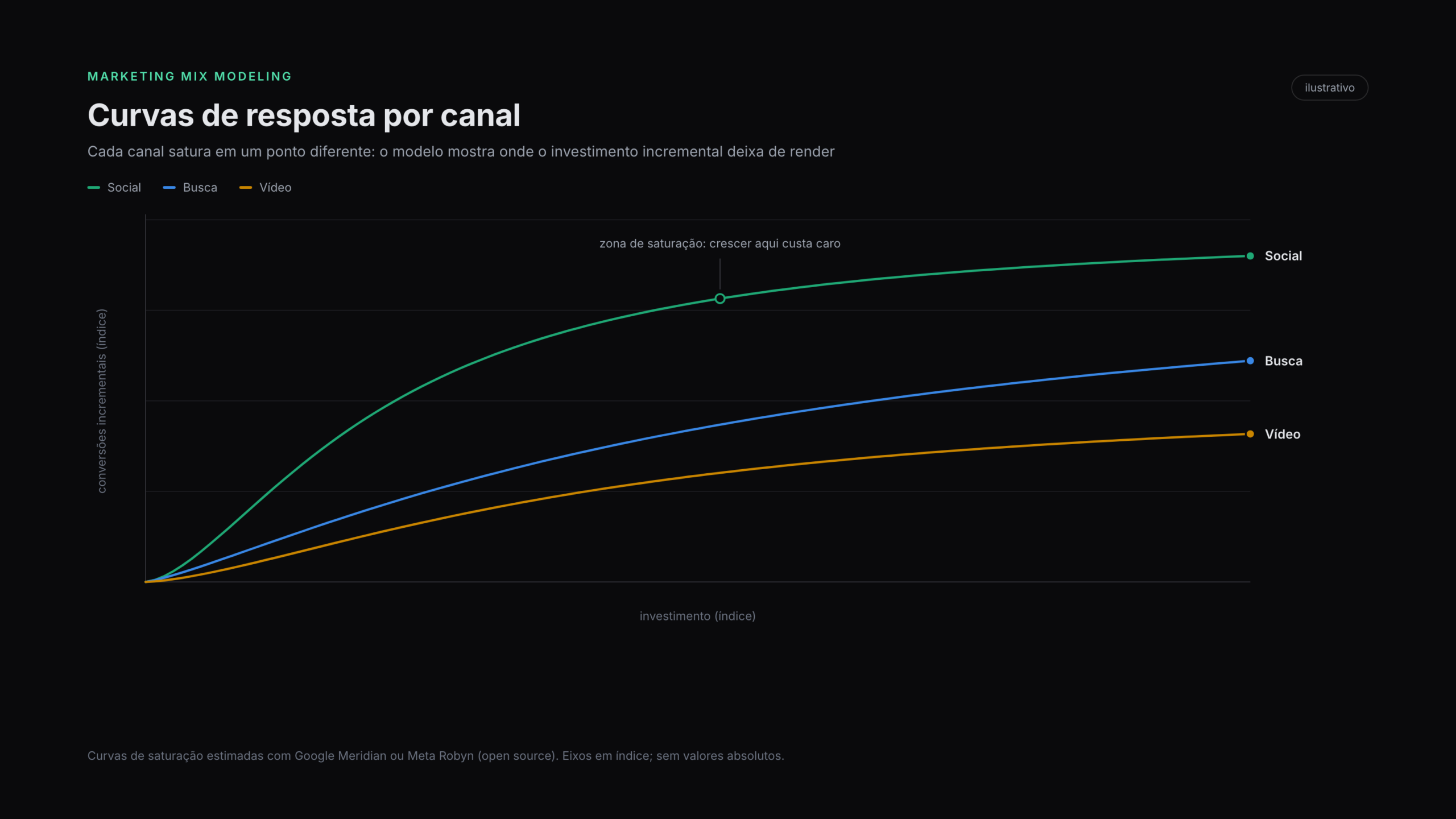
We model each channel's true incremental impact with Google Meridian or Meta Robyn and turn the curves into practical budget reallocation scenarios. Project-based, no annual software license.
You spend across three or more channels and every platform claims credit for the same conversion.
Last-click is the official budget yardstick, but nobody in the room actually trusts it.
iOS 14+, cookie deprecation and modeled conversions have left your digital attribution full of holes.
Upper-funnel channels (YouTube, TV, OOH, influencers) look expensive because last-click can't see their effect.
Questions like 'what happens if we cut this channel by 20%?' get answered with gut feeling.
You've priced enterprise MMM platforms and the annual license doesn't make sense at your stage.
We gather 18 to 24 months of history: spend per channel, outcomes, seasonality, promotions and pricing. Before modeling anything, we tell you straight whether your data supports a reliable model.
We build the model in Google Meridian or Meta Robyn, the two open-source reference frameworks, with statistical validation, robustness checks and calibration against experiments where available.
We turn response curves and saturation points into decisions: where to cut, where to scale, and the mix that maximizes return on the same total budget.
Every quarter we re-run the model on fresh data, compare forecast to actuals and adjust the plan. The model keeps learning from your operation instead of becoming a forgotten slide.
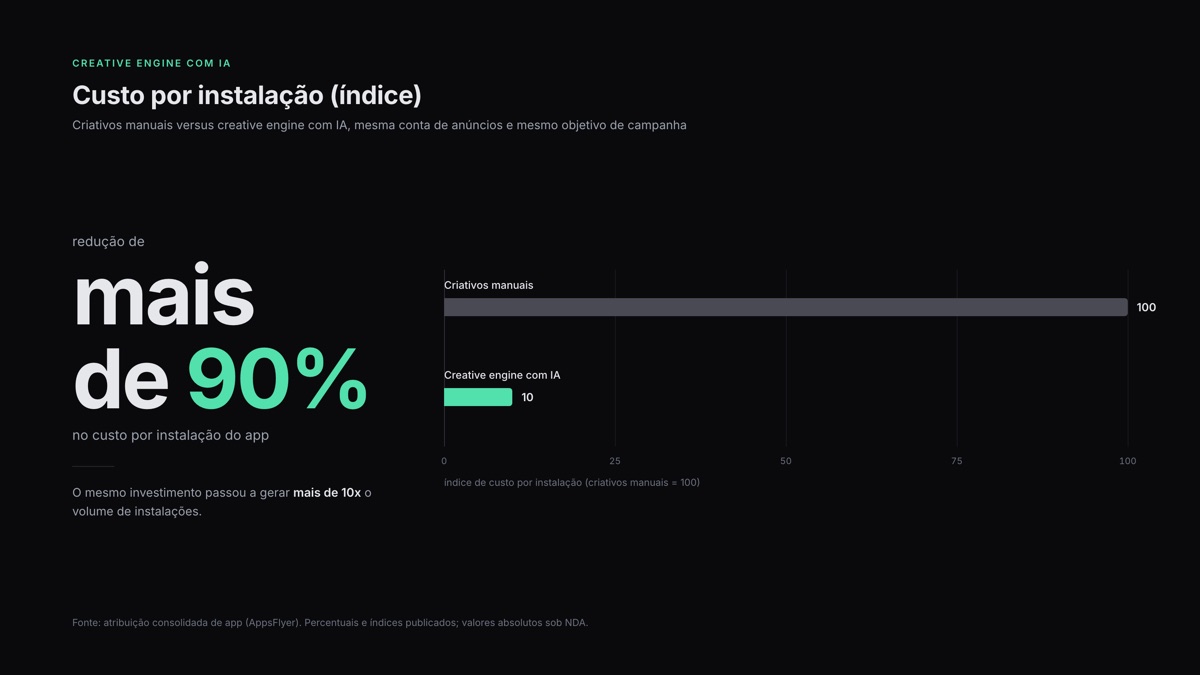
90%
drop in cost per install on FESTAS, our own product, once budget and creative followed consolidated app attribution (AppsFlyer) instead of platform last-click.
10x
more installs for the same spend after reallocating budget to the formats and channels with the highest incremental response.
80%
drop even under the most conservative read, the platform's own attribution: when two independent sources tell the same story, the decision becomes defensible.
Every platform claims the conversion is theirs. Marketing mix modeling answers the question digital attribution can't: how much each channel actually adds, and what happens to results when the budget moves.
Click-based attribution sees the end of the journey and ignores the rest. Upper-funnel channels look expensive, retargeting looks cheap, and budget drifts toward whoever harvests the conversion rather than whoever created it. iOS 14+, cookie loss and modeled conversions made the gap worse.
MMM attacks the problem from a different angle: instead of tracking people, it statistically models the relationship between spend and outcomes over time, controlling for seasonality, pricing and promotions. It's the technique large advertisers have used for decades, now accessible through open-source frameworks: Google Meridian and Meta Robyn.
Our difference is the format: an on-demand project, not an annual license. You get the calibrated model, the scenarios and the recommendation. And you keep the code.
Audit: 18 to 24 months of spend and outcome history, with an honest viability read.
Modeling in Google Meridian or Meta Robyn, with statistical validation and robustness checks.
Simulated reallocation scenarios: cuts, increases and the optimal mix for the same budget.
Quarterly recalibration: forecast versus actuals, model updated, plan adjusted.
90%
drop in cost per install once our own product's media followed consolidated attribution data instead of last-click
10x
more installs for the same spend after data-driven reallocation
0
annual licenses: you pay for the project and keep the model
Four to eight weeks from kickoff to scenario presentation, depending on data quality. Quarterly recalibrations are much faster: the model already exists and is simply re-estimated on fresh data.
Ideally 18 to 24 months of spend and outcomes at weekly granularity. With less than that, the initial audit tells you whether a model holds up or whether it's worth collecting a few more months first.
Fixed-scope project: audit, modeling and scenarios, priced upfront before kickoff. Quarterly recalibration is an optional recurring package. No software license, no mandatory retainer, no percentage of media spend.
You do. Code, data, documentation and assumptions live in your environment. If you later want your data team to run it in-house, there is zero agency lock-in.
Async-first: written updates, recorded walkthroughs and live calls scheduled in your time zone. Deliverables in English, Portuguese or Spanish.
Tell us which channels you run and what you measure today. The initial audit tells you whether an MMM holds up on your data and what it would unlock.
Talk to Max MCampaign management across Meta, TikTok and Google with structured accounts, data-driven creative and CPI, CPA and ROAS optimization. Our most recent engagement cut cost per install by over 90%.
Explore serviceWe implement your full data collection layer, from in-app event to warehouse, and activate behavior-based CRM across push, in-app, email and WhatsApp. Governed taxonomy, unified identity, funnels measured end to end.
Explore serviceAI pipelines that turn one real product screenshot into 180+ ad variations, plus agents that research, write, review and publish content. For FESTAS, cost per install dropped by more than 90%.
Explore service